
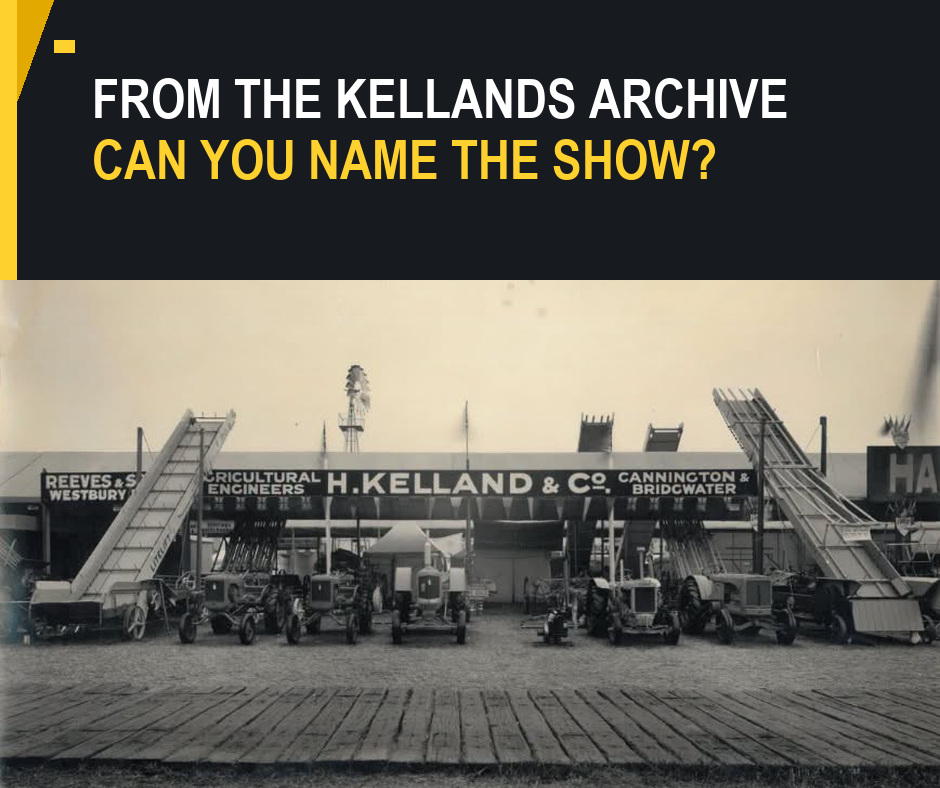
The front axle of a tractor might help date a photograph from the Kellands archive. One of our longstanding shareholders shared this picture of a row of tractors at an agricultural show, with two tall elevators raised above the stand. We think it was taken in 1938 or 1939. When we put it on Facebook, people spotted details we’d missed, from the shape of the mudguards to the lettering on the neighbouring stand.
A closer look at the Kellands archive photograph
The sign across the middle reads H. Kelland & Co., Cannington & Bridgwater. Look to the left, just below the raised elevator, and you can make out Reeves and Westbury. One follower recognised the name and pointed us towards the agricultural engineers at Bratton Iron Works, near Westbury.
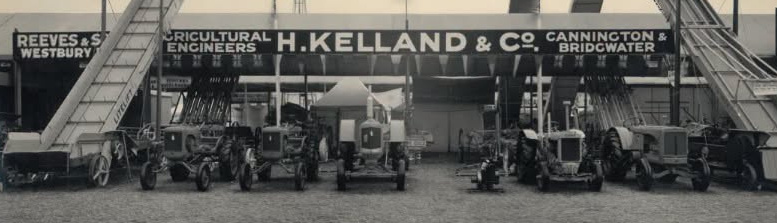
Farmers used elevators like these to lift hay, corn or straw up to a stack. Reeves advertised folding versions in the 1930s. The Museum of English Rural Life also has a working scale model from around 1900 that Reeves took to agricultural shows to demonstrate how an elevator worked. The machine in our photo is still to be identified. See the museum’s guide to its demonstration models.
Three clues from the vintage tractors
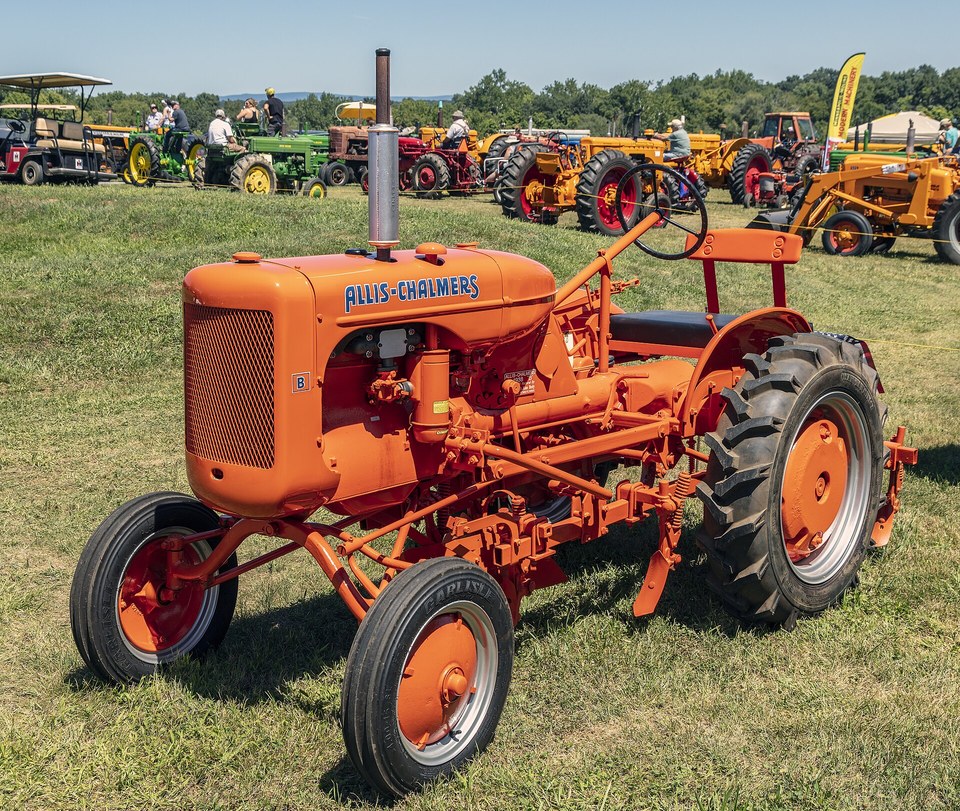
- Allis-Chalmers B and WF. One reader picked out a front axle they associated with the B and a squared front they thought belonged to a WF. The University of Nebraska tested a Model B in January 1938. It had been introduced the year before with rubber tyres as standard, and British production began in 1947. If the reader’s identification is right, a Model B at a 1938 or 1939 show would have been a fairly new American import. See the Pallot Museum’s 1938 Model B.
- Minneapolis-Moline. The flat topped mudguards caught one reader’s eye. Another suggested a Minneapolis-Moline ZTS. The shape of the mudguards is a detail readers can compare with surviving machines and period photographs.
- Case Model R or C. Two readers thought they could see an early Model R with plainer front bodywork. One compared it with their own 1938 Model R, which has a styled front. Another reader listed a Case Model C among the machines they could see.
When farm horses still outnumbered tractors
The tractors lined up on the Kellands stand were still a relatively uncommon sight on British farms. Figures given to Parliament put the number of agricultural tractors in the UK at about 55,000 in 1939. Around 724,000 horses were still being used for agriculture that June. By January 1948, the tractor census counted about 245,000, more than four times the 1939 estimate. Tractor figures in Hansard. Horse figures in Hansard.
Could it be the 1939 Bath & West Show in Bridgwater?
One Facebook follower remembered that the Bath & West Show used to move from town to town. Bath Archives records the 1938 show in Plymouth, and the organiser has a separate period photograph of the show in Bridgwater the following year. That puts Bridgwater in 1939 among the strongest leads for our picture. See the organiser’s photograph of the 1939 show. View the catalogue entry for Plymouth in 1938.
Bath Record Office holds a plan of the 1939 showground. A programme naming H. Kelland & Co. and Reeves, or another photograph showing the same stands side by side, could help us match the scene to the site. View the showground plan catalogue entry.
What the photograph brought back
Blacksmith William Kelland started the original agricultural machinery business in 1858. This photograph captures a chapter before Kellands Plant Sales was formed in 1950. It brought back memories for former staff, too. One Facebook follower recalled starting work at Cannington in 1953. Another started selling for Kellands in Bristol in 1979 and remarked on how much had changed in roughly 40 years. Read more about the history of Kellands.
If you recognise the showground, a tractor or a neighbouring stand, tell us on the original Facebook post. If there’s an old show programme or a photograph from another angle tucked away at home, we’d love to see it. Get in touch with the Kellands team.